The John A. Dutton e-Education Institute has launched the Teaching and Learning Showcase, a web-based resource designed to help faculty members create inspiring educational materials and experiences.
Most of my work is related to local scale solutions to global scale problems, specifically looking at the role of local municipal governments in achieving climate solutions.
The impacts of climate change affect us locally. The good news and the bad news about climate change is that it touches virtually everything we already care about. By connecting with our community on the issues that they already value, we can build consensus to address these challenges and disentangle solutions from the political infighting so often associated with climate change itself.
An appreciation of the interconnected nature of our choices and the environment around us, an ability to think critically about nuanced challenges and creating positions based on scientific evidence, an enhanced ability to communicate complicated science to a broad audience.
Even if our national and international efforts to reduce climate change suddenly become infinitely more effective and fast moving, there is still so much work to be done to make our existence on this planet a more sustainable one. There’s room for all of us in this field, and we need to carry what we learn to all other aspects of our lives.
Students graduating with a BS or BA in Energy and Sustainability Policy are prepared to work at the intersection of science and policy – ensuring that we’re using the best available science to make sound policy decisions. We have many students who go on to work in various governmental agency capacities or who lead sustainability efforts at a wide range of non-profit and private companies. You can choose your own adventure with our degree.
The major I teach in (Energy and Sustainability Policy) is offered through World Campus. However, we don’t let distance limit our students from having engaging real world experiences! We’ve had students complete projects in service to University Park campus operations as well as informing and implementing our regional climate action and adaptation plan. Beyond that, we support students in engagement opportunities in their own communities, helping them network right where they are.
When I enrolled in college, I initially chose Creative Writing as my major. My first semester I had a class very much like Penn State’s GEOG 30N (Environment and Society in a Changing World) and I was hooked. I changed my major and while I perhaps didn’t have a good sense of what I wanted to do with my geography and environmental studies degrees, I knew I wanted to leave the world a better place than I found it. It was while working in the private sector on greenhouse gas emissions reductions projects that I had the opportunity to design, build, and teach my first World Campus course – and that path led me here.
When I’m not spending time with my daughter, I really enjoy thrifting and stained glass (this is a relatively new hobby for me!). I’m still learning a lot about the basics of stained glass, but am quite proud of the pieces I’ve been able to produce so far and look forward to continuing to learn about this art form as I go.
The work we’ve accomplished here in at the university and the Centre Region to reduce greenhouse gas emissions and prepare for the impacts of a changing climate. While larger scale government responses to this issue can be frustratingly slow and inadequate, working to make our community a better place to live is immensely rewarding and a great way to get to know your neighbors.
I would be less afraid of failure. As an undergrad, I avoided classes I didn’t feel confident I could earn an A in – guarding my GPA for now seemingly arbitrary reasons. As a result, I didn’t challenge myself as much as I wish now that I would have.
Jane Sutterlin and Maria Wherley, both instructional designers in the John A. Dutton E-education Institute, will discuss how technology and learning science can improve teaching. The webinar will be broadcast from 10 to 11 a.m. EST on Wednesday, July 28.
In 2020, Penn State and the University of Freiburg launched a pilot program to create collaborative, integrated virtual classroom courses by providing development and implementation money to faculty teams.
Penn State's College of Earth and Mineral Sciences (EMS) recognized exceptional students and faculty for their academic excellence, service and leadership during its annual Wilson Awards Celebration, held virtually on Sunday, April 11. The Wilson Awards are named in honor of Matthew and Anne Wilson, major benefactors of the college.
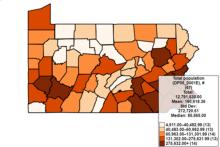
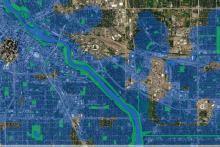
Recent Master of Geographic Information Systems graduate Nate Geyer has always been interested in epidemiology and geography. As a research support assistant in the Department of Public Health Sciences in the College of Medicine, he was able to put those interests together by creating a new version of the LionVu cancer mapping tool.
As one of the pioneers of online instruction at Penn State, David DiBiase watched for three decades as programs offered through the John A. Dutton e-Education Institute broadly expanded access to education.
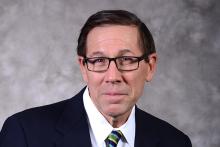
Todd Bacastow, teaching professor in the College of Earth and Mineral Sciences at Penn State, has been appointed to the board of directors of the United States Geospatial Intelligence Foundation (USGIF) for a three-year term.