
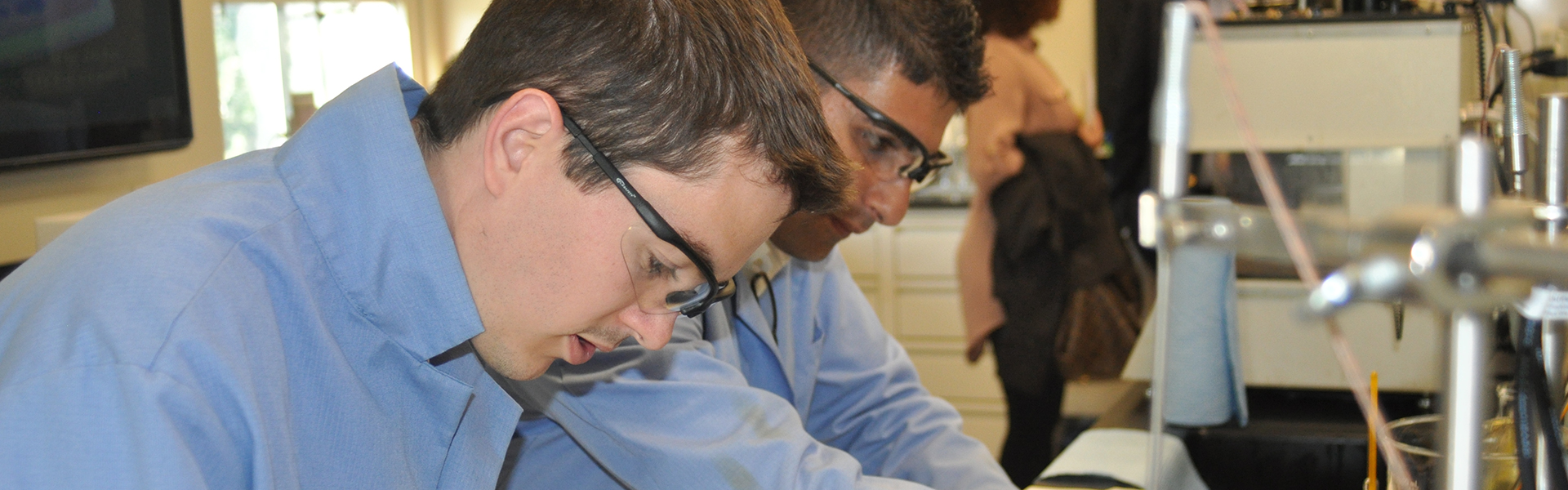
The John and Willie Leone Family Department of Energy and Mineral Engineering helps solve the world’s energy problems through high-quality, innovative teaching, research, and service. From mineral recovery to its use, the department plays a major role in the "power of life." Its mission is to help supply society with an affordable supply of energy and minerals; work to ensure human health and safety; and protect and maintain the quality of the environment.
Department head: Luis Ayala
Associate Head of Diversity, Equity, and Inclusion: Chiara Lo Prete
Associate Head for Undergraduate Education: Eugene Morgan
Associate Head for Graduate Education: Shimin Liu
Degrees offered: B.S., B.A., M.S., Ph.D., minors, and certificates
Visit Department Website: https://eme.psu.edu

Old electronics and solar panels could become a new, domestic source for critical and strategic materials through Intel-E-Waste, a startup whose technology builds on foundational research from Penn State.

A new approach to plastic recycling being explored at Penn State could make the process more efficient by using tiny particles of coal, according to researchers. On the latest episode of “Growing Impact,” researchers discussed how the technique uses laser light to generate heat at the molecular scale, potentially allowing plastics to be broken down into their basic building blocks and reused.

Renee Obringer, assistant professor of energy and mineral engineering at Penn State, will give the talk “Understanding climate change impacts on renewable energy: Insights from explainable AI” at 2 p.m. on Friday, Oct. 2, in 117 Earth and Engineering Sciences Building on the University Park campus. The talk will also be available via Zoom.

As new regulations and changes in global energy markets affect electricity costs, Penn State alumna Madalyn Guzman Loffredo is there to help. She helps Pennsylvania schools, hospitals and other large organizations make smarter energy decisions that can protect their budgets and help strengthen local communities.

Storing energy as heat is a proven pathway to address the challenge solar power faces when it’s dark or cloudy outside by enabling the capture, storage and on-demand release of thermal energy. The process, called high-temperature thermal energy storage (TES), however, can be prohibitively expensive. Researchers at Penn State have found that steel slags — a rock-like waste byproduct of the steelmaking process — may potentially serve as a low-cost, heat storage candidate for TES applications.

Melissa Gonte, a doctoral student in Penn State’s John and Willie Leone Family Department of Energy and Mineral Engineering (EME), has been awarded a scholarship from The Copper Club for her academic excellence, leadership and work related to the copper industry. She is one of eight recipients awarded the scholarship this year by the select community dedicated to promoting the next generation of industry talent.

Kat Hogan is a senior majoring in energy engineering, and she found her home as an undergraduate researcher in Penn State’s Center for Critical Minerals. She’s interested in sustainability — particularly in the energy sector — and said critical minerals sourcing is essential to a sustainable future for the energy industry.

The construction of new data centers is shaping up to be a defining issue in the 2026 midterm elections. Politicians in both parties have been distancing themselves from data centers in the face of public discontent around the issue, with public backlash leading to the freezing of dozens of data center projects nationwide this year.

This summer was a time for travel, research, internships and expanding classroom lessons for many students in the College of Earth and Mineral Sciences.

The AI Center of Excellence in Teaching and Learning has awarded 46 grants to Penn State faculty and faculty teams through the inaugural cycle of two instructional innovation grant programs supporting the thoughtful integration of generative artificial intelligence into teaching and learning.
Old electronics and solar panels could become a new, domestic source for critical and strategic materials through Intel-E-Waste, a startup whose technology builds on foundational research from Penn State.
A new approach to plastic recycling being explored at Penn State could make the process more efficient by using tiny particles of coal, according to researchers. On the latest episode of “Growing Impact,” researchers discussed how the technique uses laser light to generate heat at the molecular scale, potentially allowing plastics to be broken down into their basic building blocks and reused.
Renee Obringer, assistant professor of energy and mineral engineering at Penn State, will give the talk “Understanding climate change impacts on renewable energy: Insights from explainable AI” at 2 p.m. on Friday, Oct. 2, in 117 Earth and Engineering Sciences Building on the University Park campus. The talk will also be available via Zoom.
As new regulations and changes in global energy markets affect electricity costs, Penn State alumna Madalyn Guzman Loffredo is there to help. She helps Pennsylvania schools, hospitals and other large organizations make smarter energy decisions that can protect their budgets and help strengthen local communities.
Storing energy as heat is a proven pathway to address the challenge solar power faces when it’s dark or cloudy outside by enabling the capture, storage and on-demand release of thermal energy. The process, called high-temperature thermal energy storage (TES), however, can be prohibitively expensive. Researchers at Penn State have found that steel slags — a rock-like waste byproduct of the steelmaking process — may potentially serve as a low-cost, heat storage candidate for TES applications.
Melissa Gonte, a doctoral student in Penn State’s John and Willie Leone Family Department of Energy and Mineral Engineering (EME), has been awarded a scholarship from The Copper Club for her academic excellence, leadership and work related to the copper industry. She is one of eight recipients awarded the scholarship this year by the select community dedicated to promoting the next generation of industry talent.
Kat Hogan is a senior majoring in energy engineering, and she found her home as an undergraduate researcher in Penn State’s Center for Critical Minerals. She’s interested in sustainability — particularly in the energy sector — and said critical minerals sourcing is essential to a sustainable future for the energy industry.
The construction of new data centers is shaping up to be a defining issue in the 2026 midterm elections. Politicians in both parties have been distancing themselves from data centers in the face of public discontent around the issue, with public backlash leading to the freezing of dozens of data center projects nationwide this year.
This summer was a time for travel, research, internships and expanding classroom lessons for many students in the College of Earth and Mineral Sciences.
The AI Center of Excellence in Teaching and Learning has awarded 46 grants to Penn State faculty and faculty teams through the inaugural cycle of two instructional innovation grant programs supporting the thoughtful integration of generative artificial intelligence into teaching and learning.