
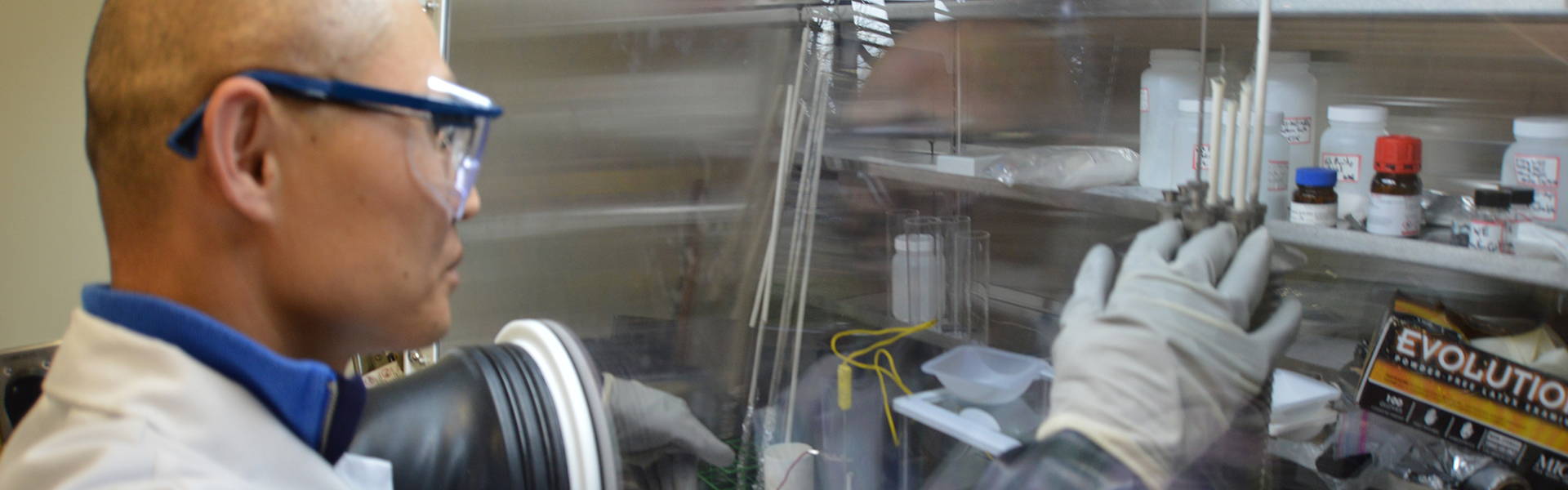
The Department of Materials Science and Engineering at Penn State is an international leader in materials education and research. As a top-ranked program, the department thrives on a rich collaboration between faculty, staff, students, and researchers to promote a well-rounded academic experience and innovative research opportunities. Our department offers ABET accredited degree programs at both the undergraduate and graduate levels. View the information below to learn more.
Department head: John Mauro
Associate Head of Diversity, Equity, and Inclusion: Enrique Gomez
Associate Head for Undergraduate Education: Amy Robinson
Associate Head for Graduate Education: Venkatraman Gopalan
Degrees offered: B.S., M.S., Ph.D., and minors
Website: https://matse.psu.edu

Penicillin has cured syphilis cases since 1943, but symptoms for the sexually transmitted infection, known as "the great imitator," mimic many other diseases and can come and go without treatment while the infection keeps causing harm. If it remains undetected, it can spread to partners and to babies during pregnancy, causing lifelong effects. A new rapid test developed by a team led by Penn State researchers detects lower levels of the two types of antibodies the body makes to fight the syphilis bacteria and respond to disease-related cell damage, potentially leading to earlier interventions and fewer appointments for patients.

Adrianne Rosales, associate professor of chemical engineering at the University of Texas at Austin, will give the talk “Multiscale control of dynamic covalent hydrogels for bioinspired applications” at 3:05 p.m. on Thursday, Oct. 15, in 10 Sparks Building on the University Park campus.

Inside the human brain, billions of individual neurons connect to form a vast network capable of rapidly processing information and electrical signals. A team of researchers and engineers at Penn State is taking inspiration from these natural computers to build soft networks of water-based droplets, connected by membranes like those found in the walls of living cells. Their networks lay the foundation for a new kind of soft computer built for wet environments, capable of sensing and processing information with ions much like silicon chips do with electrons, but at far lower energy cost.

A material thinner than a human hair may foster faster computing devices that demand less energy and store more data, according to a multi-institutional team led by researchers in the Penn State College of Earth and Mineral Sciences and supported by the U.S. National Science Foundation (NSF).

As part of their ongoing partnership, Penn State Sustainability and the Pennsylvania GreenGov Council will once again present a monthly webinar series to educate government officials, students, faculty and community leaders about sustainability issues and progress throughout the commonwealth. The 2026-27 series kicks off at noon on Friday, Oct. 16, with a presentation highlighting sustainability initiatives in Philadelphia and Pittsburgh. The webinars are free and open to all, and registration is required.

A new approach to plastic recycling being explored at Penn State could make the process more efficient by using tiny particles of coal, according to researchers. On the latest episode of “Growing Impact,” researchers discussed how the technique uses laser light to generate heat at the molecular scale, potentially allowing plastics to be broken down into their basic building blocks and reused.

Pinshane Y. Huang, Racheff Faculty Scholar in the Department of Materials Science and Engineering at the University of Illinois, Urbana-Champaign, will give the talk “Building a new era of atom-by-atom materials characterization with electron ptychography” at 3:05 p.m. on Thursday, Oct. 8, in 10 Sparks Building on the University Park campus.

Nuclear energy is a clean, low-carbon power source that can generate electricity 24 hours a day, according to the International Atomic Energy Agency. New reactor technologies, such as molten salt reactors — which use high-temperature liquid salts instead of water as the primary coolant — have the potential to improve fuel utilization and support more efficient fuel recycling, among other possible benefits, according to a team led by scientists in Penn State’s College of Earth and Mineral Sciences.

Zi-Kui Liu, the Corning Faculty Fellow in Materials Science and Engineering in the Penn State College of Earth and Mineral Sciences, will receive the 2026 Materials Theory Award from the Materials Research Society. Liu will receive his award and present a lecture, “The Quest for Predictability — Thermodynamics as a Foundation Across Scales and Domains,” as part of the Materials Research Society’s annual meeting from Nov. 29 to Dec. 4 in Boston.

Lauren Zarzar, professor of chemistry and materials science and engineering, has been named a recipient of the 2026 Schmidt Science Polymath Award. This award supports mid-career researchers who are expanding into new research domains, experimenting with new methodologies, and inspiring scientific breakthroughs.
Penicillin has cured syphilis cases since 1943, but symptoms for the sexually transmitted infection, known as "the great imitator," mimic many other diseases and can come and go without treatment while the infection keeps causing harm. If it remains undetected, it can spread to partners and to babies during pregnancy, causing lifelong effects. A new rapid test developed by a team led by Penn State researchers detects lower levels of the two types of antibodies the body makes to fight the syphilis bacteria and respond to disease-related cell damage, potentially leading to earlier interventions and fewer appointments for patients.
Adrianne Rosales, associate professor of chemical engineering at the University of Texas at Austin, will give the talk “Multiscale control of dynamic covalent hydrogels for bioinspired applications” at 3:05 p.m. on Thursday, Oct. 15, in 10 Sparks Building on the University Park campus.
Inside the human brain, billions of individual neurons connect to form a vast network capable of rapidly processing information and electrical signals. A team of researchers and engineers at Penn State is taking inspiration from these natural computers to build soft networks of water-based droplets, connected by membranes like those found in the walls of living cells. Their networks lay the foundation for a new kind of soft computer built for wet environments, capable of sensing and processing information with ions much like silicon chips do with electrons, but at far lower energy cost.
A material thinner than a human hair may foster faster computing devices that demand less energy and store more data, according to a multi-institutional team led by researchers in the Penn State College of Earth and Mineral Sciences and supported by the U.S. National Science Foundation (NSF).
As part of their ongoing partnership, Penn State Sustainability and the Pennsylvania GreenGov Council will once again present a monthly webinar series to educate government officials, students, faculty and community leaders about sustainability issues and progress throughout the commonwealth. The 2026-27 series kicks off at noon on Friday, Oct. 16, with a presentation highlighting sustainability initiatives in Philadelphia and Pittsburgh. The webinars are free and open to all, and registration is required.
A new approach to plastic recycling being explored at Penn State could make the process more efficient by using tiny particles of coal, according to researchers. On the latest episode of “Growing Impact,” researchers discussed how the technique uses laser light to generate heat at the molecular scale, potentially allowing plastics to be broken down into their basic building blocks and reused.
Pinshane Y. Huang, Racheff Faculty Scholar in the Department of Materials Science and Engineering at the University of Illinois, Urbana-Champaign, will give the talk “Building a new era of atom-by-atom materials characterization with electron ptychography” at 3:05 p.m. on Thursday, Oct. 8, in 10 Sparks Building on the University Park campus.
Nuclear energy is a clean, low-carbon power source that can generate electricity 24 hours a day, according to the International Atomic Energy Agency. New reactor technologies, such as molten salt reactors — which use high-temperature liquid salts instead of water as the primary coolant — have the potential to improve fuel utilization and support more efficient fuel recycling, among other possible benefits, according to a team led by scientists in Penn State’s College of Earth and Mineral Sciences.
Zi-Kui Liu, the Corning Faculty Fellow in Materials Science and Engineering in the Penn State College of Earth and Mineral Sciences, will receive the 2026 Materials Theory Award from the Materials Research Society. Liu will receive his award and present a lecture, “The Quest for Predictability — Thermodynamics as a Foundation Across Scales and Domains,” as part of the Materials Research Society’s annual meeting from Nov. 29 to Dec. 4 in Boston.
Lauren Zarzar, professor of chemistry and materials science and engineering, has been named a recipient of the 2026 Schmidt Science Polymath Award. This award supports mid-career researchers who are expanding into new research domains, experimenting with new methodologies, and inspiring scientific breakthroughs.