
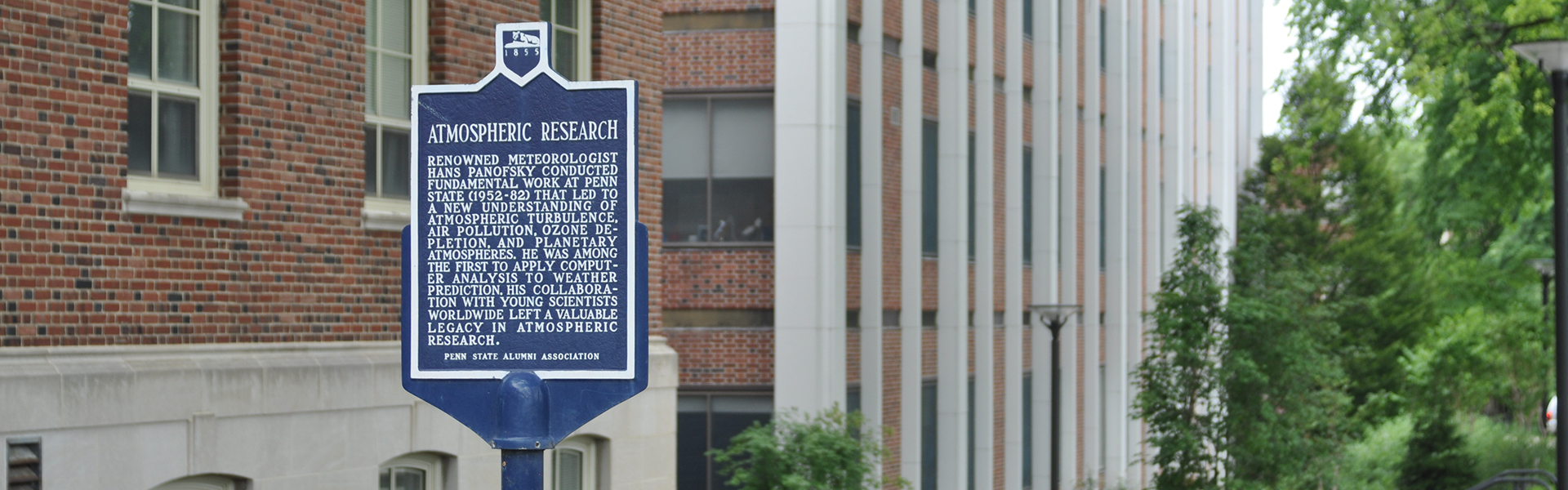
The weather and the atmosphere have a tremendous impact on business and industry, governments, and societies, and researchers in the Department of Meteorology and Atmospheric Science aim to better understand this dynamic set of systems. From modeling the intricacies of snowfall to understanding how tornadoes and hurricanes take shape to detailing the atmospheric chemistry of the rainforest, researchers cover the gamut of the interactions between the atmosphere and the land.
Department Head: Paul Markowski
Associate Head of Diversity, Equity, and Inclusion: Melissa Gervais
Associate Head for Undergraduate Programs: Jon Nese
Associate Head of Graduate Programs: Jerry Harrington
Degrees offered: B.S., M.S., Ph.D., minors, and certificates
Website: https://met.psu.edu

Most natural gas leakage in Indianapolis likely originates from homes and other buildings, not exterior pipelines and large-scale distribution infrastructure that deliver the fossil fuel, according to Penn State researchers who assessed nearly a decade of data.

Tornado warnings can give people time to seek shelter, but meteorologists still face a fundamental challenge in delivering accurate warnings: determining which storms will actually produce a tornado.

The American Geophysical Union (AGU) has selected two faculty members in Penn State’s College of Earth and Mineral Sciences to receive awards recognizing their research contributions: Jose D. Fuentes, professor of meteorology and atmospheric science, and Tushar Mittal, the Wilson Faculty Fellow of geosciences.

The Penn State's Institute of Energy and the Environment (IEE) has welcomed four new faculty members whose research expands the breadth of expertise within its interdisciplinary community.

If there’s one thing a career in meteorology and atmospheric science taught Penn State alumna Cheryl Nelson, it’s that things can change in the blink of an eye. She graduated in 2002 and since then has been navigating through storms and sunny days in a career that’s shifted more than a Central Pennsylvania season.

This summer was a time for travel, research, internships and expanding classroom lessons for many students in the College of Earth and Mineral Sciences.

Penn State has selected 16 faculty members for its 2026-27 AI-Aware Faculty Leaders program, a co-sponsored initiative of the AI Center of Excellence in Teaching and Learning and the Schreyer Institute for Teaching Excellence. The faculty-driven program is designed to help departments, colleges and campuses respond thoughtfully and effectively to the opportunities and challenges artificial intelligence presents for teaching and learning.

Penn State is the newest member of the LearningWell Coalition, a national network of colleges and universities that promote flourishing in and beyond college.

As part of our regular “We Are!” feature, we recognize 21 Penn Staters who have gone above and beyond what’s asked of them in their work at the University, including Lan Lewis, Katina Posney, and Leanne Sulewski.

For Sierra Hill, a recent trip to Indiana helped bring the next phase of a climate science career into focus. Hill, a master’s degree student in the Department of Meteorology and Atmospheric Science at Penn State, spent two weeks at FluxCourse, an intensive training program focused on measurement, synthesis and modeling of land-atmosphere carbon, water and energy fluxes.
Most natural gas leakage in Indianapolis likely originates from homes and other buildings, not exterior pipelines and large-scale distribution infrastructure that deliver the fossil fuel, according to Penn State researchers who assessed nearly a decade of data.
Tornado warnings can give people time to seek shelter, but meteorologists still face a fundamental challenge in delivering accurate warnings: determining which storms will actually produce a tornado.
The American Geophysical Union (AGU) has selected two faculty members in Penn State’s College of Earth and Mineral Sciences to receive awards recognizing their research contributions: Jose D. Fuentes, professor of meteorology and atmospheric science, and Tushar Mittal, the Wilson Faculty Fellow of geosciences.
The Penn State's Institute of Energy and the Environment (IEE) has welcomed four new faculty members whose research expands the breadth of expertise within its interdisciplinary community.
If there’s one thing a career in meteorology and atmospheric science taught Penn State alumna Cheryl Nelson, it’s that things can change in the blink of an eye. She graduated in 2002 and since then has been navigating through storms and sunny days in a career that’s shifted more than a Central Pennsylvania season.
This summer was a time for travel, research, internships and expanding classroom lessons for many students in the College of Earth and Mineral Sciences.
Penn State has selected 16 faculty members for its 2026-27 AI-Aware Faculty Leaders program, a co-sponsored initiative of the AI Center of Excellence in Teaching and Learning and the Schreyer Institute for Teaching Excellence. The faculty-driven program is designed to help departments, colleges and campuses respond thoughtfully and effectively to the opportunities and challenges artificial intelligence presents for teaching and learning.
Penn State is the newest member of the LearningWell Coalition, a national network of colleges and universities that promote flourishing in and beyond college.
As part of our regular “We Are!” feature, we recognize 21 Penn Staters who have gone above and beyond what’s asked of them in their work at the University, including Lan Lewis, Katina Posney, and Leanne Sulewski.
For Sierra Hill, a recent trip to Indiana helped bring the next phase of a climate science career into focus. Hill, a master’s degree student in the Department of Meteorology and Atmospheric Science at Penn State, spent two weeks at FluxCourse, an intensive training program focused on measurement, synthesis and modeling of land-atmosphere carbon, water and energy fluxes.